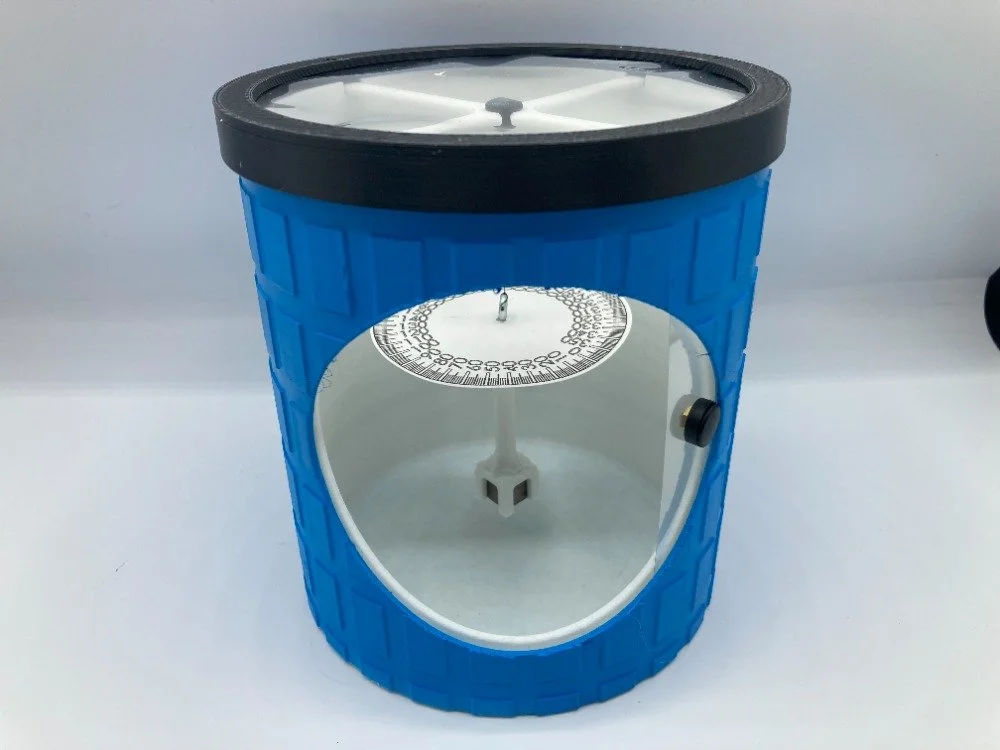
STEM Education Device for Science Classrooms
We recently announced the invention of a device that is a torsional pendulum STEM learning device for an interactive classroom experiment. The device is named RESUMPTI™. It features non-uniform rotational motion that operates in both clockwise and counterclockwise directions within a magnetic field and oxygen. The device utilizes diamagnetic materials such as bismuth and plastic to enable rotation through interaction with magnetism. The device continues to rotate despite air resistance, gravity, and friction. Oxygen, being paramagnetic, influences the magnetic behavior of the device. It generates torsional potential energy when twisted and kinetic energy during motion. The device introduces a concept called diamagnetic resumption motion, characterized by variable angular velocity, angular acceleration, non-constant torque, fluctuating rotational kinetic energy, a potentially non-circular path of motion, weak repelling forces from diamagnetism, strong attraction from magnetic fields, and weak attractive force from paramagnetic oxygen.
The device consists of a disk or mass attached to a string or thread that twists around its axis, exhibiting non-uniform rotational motion. When displaced and released from equilibrium, it oscillates rotationally around its axis. It has an equilibrium position where the mass starts with no torque acting on it. The next process is displacement, where the mass is twisted to a certain angle, creating torsional potential energy. Then comes restoration, where, when released, the mass experiences a restoring torque that moves it back towards its equilibrium position. Finally, during oscillation, the mass overshoots the equilibrium position due to inertia, repeating the process and causing oscillatory motion. The torsional pendulum is designed to remain balanced when suspended by a thread or string. The device rotates due to magnetism when held on the thread. Rotational oscillations persist as long as magnetism is present, and there is oxygen with electrons in the air. The device has clockwise and counterclockwise rotational oscillations of over 30 degrees, occurring every few minutes, on average.